top of page


Why Evening Darkness Is So Crucial for Your Health
We often hear that getting enough daylight is important for our health. But there is another side to the story that is just as important: darkness. In today's world, darkness has become increasingly rare. Our evenings are filled with bright LED lighting, televisions, smartphones, tablets and illuminated streets. While these technologies have made modern life more convenient, they have also dramatically changed the light environment our bodies evolved in. Photo by Maeghan Smul

Good Light Group
Sep 18


The Perfect Indoor Lighting for Health: How to Optimise Light Throughout the Day
Most people think of indoor lighting as something that simply helps us see. But good indoor lighting does much more than illuminate a room. The quality, intensity and timing of light have a profound effect on your circadian rhythm, sleep, energy levels, mood, productivity and overall health. Modern life means we spend around 90% of our time indoors, often under lighting that is too dim during the day and far too bright in the evening. As a result, many people experience poor
Good Light Group
Sep 18


Good Light Is Not Just About Seeing Better, It's About Sleeping Better
When most people think about lighting, they think about vision. We switch on a lamp to read a book, illuminate a workspace or make a room feel cosy. For more than a century, lighting has been designed primarily to help us see better. But science has revealed that light does far more than illuminate our surroundings. It also tells our body when to be awake and when to prepare for sleep. In other words, good light isn't only about seeing better, it's also about sleeping better.
Good Light Group
Sep 18


The Indoor Generation: Why We Spend So Much Time Indoors, and Why It Matters
Take a moment to think about your average day. You wake up in your home, travel to school or work, spend the day in an office or classroom, return home, eat dinner and relax in front of the television before going to bed. For many people, this means spending 90% of the day indoors. From an evolutionary perspective, that's a remarkable change. For hundreds of thousands of years, humans evolved almost entirely outdoors. Our bodies, brains and biological clock developed under th
Good Light Group
Sep 14


How many lux do you actually need?
We often talk about getting “enough light” during the day. But what does enough actually mean? Is the light in your home or office bright enough? Is sitting near a window enough? And does everyone need the same amount of light? The answer depends on several factors, including the time of day, where the light is measured and, importantly, your age. Photo by Beth Macdonald on Unsplash First things first: what is lux? Lux is a measure of how much light falls on a surface. One lu
Good Light Group
Sep 14


Good Light: The Next Growth Story for Our Lighting Industry
Our Chairman Jan Denneman wrote the commentary of LED professional Review #116. This issue is focussing on the good light. In his commentary he explores why good light could become the next major growth story for the lighting industry. After decades of innovation focused on energy efficiency, LEDs, digital controls and intelligent lighting systems, the industry is entering a new phase. Increasing scientific evidence shows that light affects much more than our ability to see:
Good Light Group
Aug 31


What’s the Deal with Blue and Orange Glasses?
If you've searched for ways to improve your sleep, you've almost certainly come across blue-light-blocking glasses. They come in all shapes and colours, from almost clear lenses to bright orange or deep red ones, all promising better sleep, less eye strain and improved wellbeing.But do they really work?The answer is more nuanced than many advertisements suggest. Photo by nacer eddine on Unsplash Why light colour matters Our eyes do much more than allow us to see. They also c
Good Light Group
Aug 17


The Light Spectrum Throughout the Day: Why Nature Changes Colour
Have you ever noticed how different the world looks at sunrise compared to midday or sunset? In the early morning, daylight has a warm, golden glow. Around noon, it appears bright and crisp. As evening approaches, the light becomes soft, orange and eventually fades into darkness. Photo by Sasha Freemind on Unsplash These changes are more than beautiful scenery. They are powerful biological signals that have shaped human physiology for millions of years throughout our evoluti
Good Light Group
Aug 11


Rods, Cones and Spheres: The Three Ways Your Eyes Detect Light
Most people think our eyes exist for one purpose: to help us see. In reality, our eyes have another equally important job. Besides creating vision, they constantly measure the light around us to help regulate our biological clock, hormones, alertness, mood and sleep. To do this, the retina contains three different types of light-sensitive cells. Two are responsible for vision: rods and cones. The third type, known scientifically as intrinsically photosensitive retinal ganglio
Good Light Group
Aug 6


Lumen vs Lux: What's the Difference?
When shopping for a light bulb or reading about good light, you've probably come across the terms lumens and lux. They sound similar, but they describe two very different things. Understanding the difference is essential, especially when it comes to lighting for health and wellbeing. Jan Sleepman What are lumens? Lumens (lm) measure the total amount of light a lamp produces. Think of lumens as the light output of the source itself. The higher the lumen value, the more light t
Good Light Group
Jul 27


deLIGHTed Talks Asia at GILE 2026: From Good Light to Measurable Human Outcomes
During the Guangzhou International Lighting Exhibition (GILE 2026) , deLIGHTed Talks Asia brought together an exceptional group of scientists, clinicians, lighting designers, architects, manufacturers, building professionals and industry leaders. Their backgrounds differed, but they shared one ambition: to accelerate the transition from conventional lighting to Good Light that genuinely improves people's lives. The central question throughout the event was straightforward: Ho
Good Light Group
Jul 13


How to Survive Daylight Saving Time
Daylight saving time gives us longer, brighter evenings, but it can also disrupt our natural body clock. Even weeks after the clocks change, many people still feel more tired, find it harder to fall asleep, or struggle to wake up in the morning. The reason is simple. Our body clock is primarily regulated by light. When the clocks move forward by one hour, our social schedule changes overnight, but our body clock does not. It needs time and the right light signals to adjust. P
Good Light Group
Jul 3


From energy savings to human health: why “good light” matters more than ever
A summary of the article by Jan Denneman and Dave Hollingsbee, published in Arc, a magazine for architects and interior designers. For years, the lighting industry has focused on three key goals: functionality, design, and sustainability. We have made remarkable progress in energy efficiency, circular manufacturing, and smarter lighting controls. But there is a fourth dimension that deserves equal attention: sleep, human health and performance. Photo by copernico on Unsplash
Good Light Group
Jun 22


Sunshine, sunbeds & a surprising health twist
An epidemiological study (Stevenson et al., 2024) with participants from the UK found that people who had more ultraviolet, or UV, light exposure tended to live longer compared to people with less UV exposure. That finding might sound strange, because exposure to UV light – which is part of sunlight – is commonly communicated as a health risk factor. In fact, too much UV exposure can increase the risk of skin cancer. These new findings, however, suggest a more nuanced relatio
Good Light Group
Jun 1


Light affects your health, beyond what you can see
Light is more than something you see. When it enters your eyes, it reaches parts of your brain that regulate your sleep, your mood, your alertness, and your long-term health. This happens every time you step outside, sit under a lamp, or look at a screen, whether you notice it or not. And the pattern of light you live in, bright or dim, day or night, shapes how well your body works. How light shapes your body clock Every cell in your body follows a roughly 24-hour rhythm. Thi
Good Light Group
May 16


New “chrono-schedule” helps nurses recover faster after night shifts
Jeroen Bosch Hospital (JBZ) in Den Bosch, the Netherlands, has reported encouraging early results from a new night-shift system called a “chrono-schedule”. In a pilot study, nurses working under the new system said they felt less exhausted after night shifts, had less difficulty staying awake, and recovered more quickly afterwards. Photo by Amir Arabshahi on Unsplash Instead of working a full night shift, staff worked shorter shifts from 8.00 pm to 4.00 am or from 4.00 am to
Good Light Group
Apr 22


How lighting impacts sleep: what you’ll learn in this CPD course
Sleep is fundamental to our health, performance, and wellbeing — yet it is increasingly disrupted by our everyday’s actions and the way we design and light our buildings. This CIBSE-approved CPD course explores the science of sleep, our internal body clock, and how integrative lighting design can actively support healthier sleep–wake rhythms. Photo by Gregory Pappas on unsplash Understanding sleep: more than just “switching off” A clear overview of what sleep actually is, bre
Good Light Group
Apr 11


Step 4 how to manage light in the evening
Sleep doesn’t start when your head hits the pillow, it begins hours earlier with the signals you send your brain. One of the most important signals is light. To support deep, restful sleep, it’s recommended to keep light levels below 10 lux starting three hours before bedtime. Photo by Giorgio Trovato on Unsplash How Light Affects Your Sleep Your brain uses light to decide whether it’s time to be awake or asleep. Bright light in the evening, especially artificial lighting a
Good Light Group
Mar 25
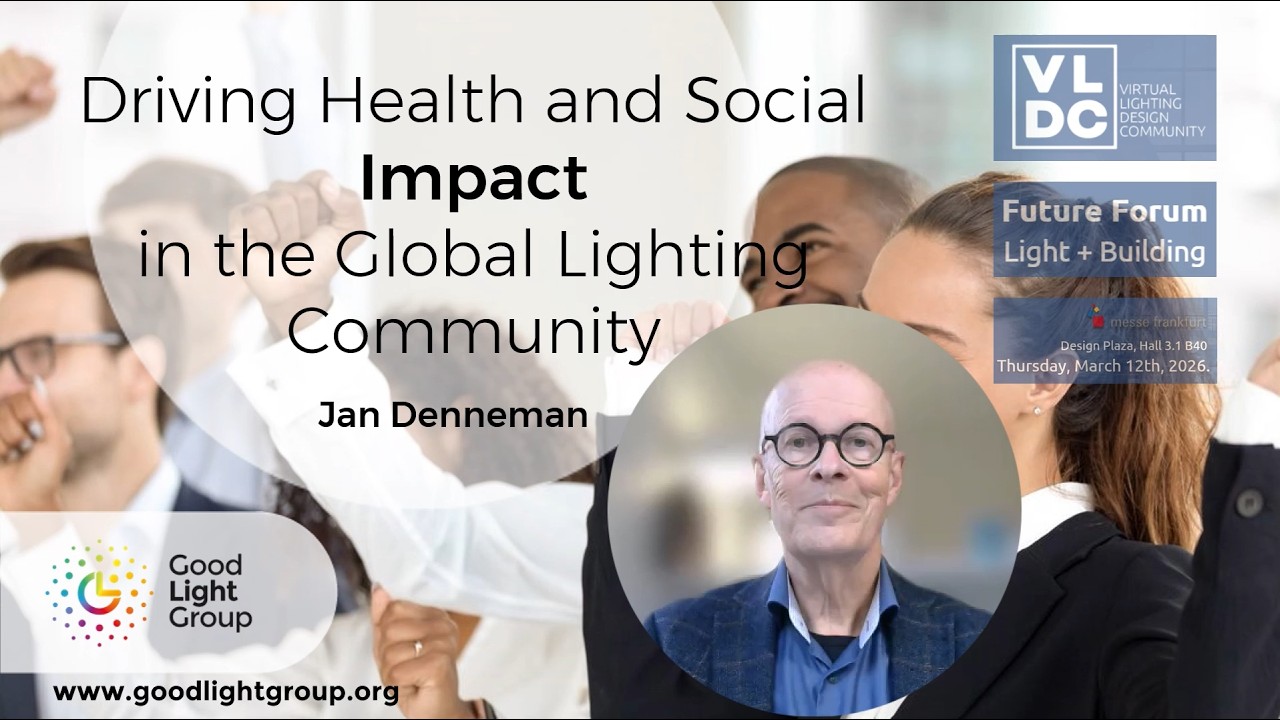
A Wake-Up Call: We Are Designing Light Against Human Biology
Last week, Jan Denneman had the opportunity to speak at Light + Building in Frankfurt as Chair of the Good Light Group. What continues to strike him is this: we spend around 90% of our time indoors, yet the light around us is fundamentally misaligned with our biology. The impact is not subtle. It shows up in poor sleep, low energy, reduced wellbeing, and long-term health risks. And still, we treat this as normal. The reality is simple. During the day, most indoor environments
Good Light Group
Mar 23


Step 2 and 3 how to optimize indoor light for better energy and focus
Spending time outdoors is ideal, but many of us still spend large portions of the day inside. When natural daylight is limited, optimizing your indoor light environment becomes essential for maintaining energy, focus, and a healthy daily rhythm. These two simple steps can make a big difference. Photo by Surface on Unsplash Step 2: Stay within one meter of a window When you’re indoors, your proximity to natural light matters more than you might think. Light intensity
Good Light Group
Mar 16
bottom of page